
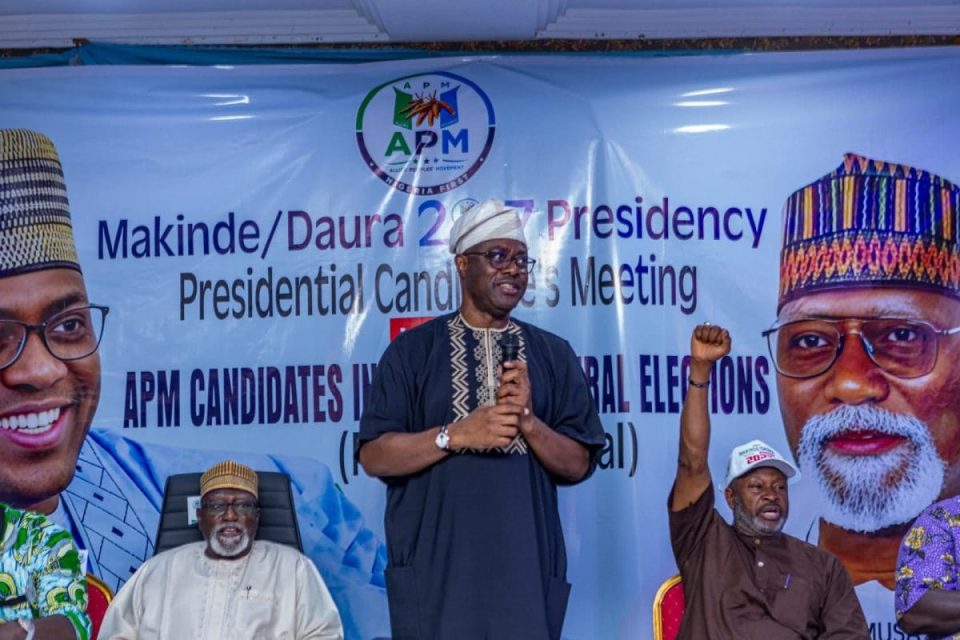
Oyo State Governor and presidential candidate of the Allied Peoples Movement (APM), Engr. Seyi Makinde, has unveiled a four-year blueprint for what he describes as a fundamental “reset” of Nigeria, with proposed reforms spanning security, education, the economy and the country’s socio-political system.
Makinde presented the vision on Monday at the APM North-Central Town Hall Meeting in Lafia, Nasarawa State, where he told party stakeholders and residents that his proposed national transformation agenda could be implemented within four years if elected president in the 2027 general election.
According to the APM presidential candidate, the proposed reset would be anchored on a new security architecture, a reformed education system, an economy driven by data, science and logic, and changes to the broader socio-political environment.
“The reset agenda can be concluded in four years,” Makinde said, citing Nigeria’s transition from military rule to democratic governance as an example of how major national changes could be achieved within a relatively short period”.
He further proposed that an APM-led administration would commence a transitional Government of National Unity on May 29, 2027, which he said would ultimately usher in what he described as “new players” and a fresh national development agenda.
“So, as your president from 29 May 2027, we will run a transitional government of national unity that will culminate in new players and an agenda for Nigeria’s sustainable development,” he said.
Security: Makinde Demands Clarity on Army Expansion
The governor also questioned the Federal Government’s approach to tackling insecurity, particularly the reported expansion of military formations across the country.
Makinde said he had examined the 2026 budget in search of provisions relating to the establishment or expansion of additional Army divisions but claimed he could not identify the relevant allocations.
He argued that confronting insecurity required more than announcing new military formations, stressing the need for corresponding planning, funding and implementation.
“Midway into 2026, insecurity is a big issue, especially in the North-Central zone,” he said, challenging the Federal Government to identify the relevant budgetary provisions for the expansion.
His comments come amid continuing security concerns in parts of the North-Central region, which featured prominently in discussions at the Lafia town hall.
Makinde: Higher Allocations Have Not Ended Hunger
The APM candidate also questioned whether increased federal allocations to state governments had translated into tangible improvements in citizens’ living conditions.
Makinde acknowledged that states had received more money from the Federation Account but argued that the increase had not, in his assessment, sufficiently addressed hunger and economic hardship.
“Yes, they claim the state government has more money from the federation account. I’m not arguing that we have more money, but has it translated to fighting hunger in our society? The answer is no,” he said.
Oyo’s Revenue Dependence Takes Centre Stage
Turning to Oyo State’s finances, Makinde said his administration inherited a state whose dependence on federal allocations was above 80 per cent in 2019.
He said efforts by his government reduced that dependence to about 65 per cent by 2022, but claimed it had subsequently risen to nearly 80 per cent.
Makinde attributed the reversal to developments following the removal of the fuel subsidy and criticised the Federal Government’s economic management, describing it as “voodoo economics.”
From Lafia, APM Pushes ‘Reset Nigeria’ Message
The Lafia engagement formed part of the APM presidential campaign’s zonal consultation programme ahead of the 2027 elections.
Before the town hall, Makinde disclosed that he had held a closed-door meeting with APM candidates from the North-Central geopolitical zone, saying the candidates would work together toward his “Reset Nigeria” agenda.
The North-Central engagement brought the campaign’s proposed national agenda into direct focus, with security, economic hardship, education, governance and institutional reform featuring prominently in the discussions.
Makinde’s four-year proposal now places security restructuring, education reform, data-driven economic planning and a proposed transitional Government of National Unity at the centre of his APM presidential campaign narrative ahead of the 2027 presidential election.
