
From Makinde’s Developmental Foundation to Adekanmbi’s Next-Phase Promise: The Case for Continuity, Competence and Sustainable Progress
By Ayantoye Christopher.
As the political conversation ahead of the 2027 governorship election in Oyo State gradually takes shape, the question of succession is assuming greater significance: who possesses the experience, administrative depth and strategic foresight to consolidate existing developmental gains and advance the state towards greater prosperity?
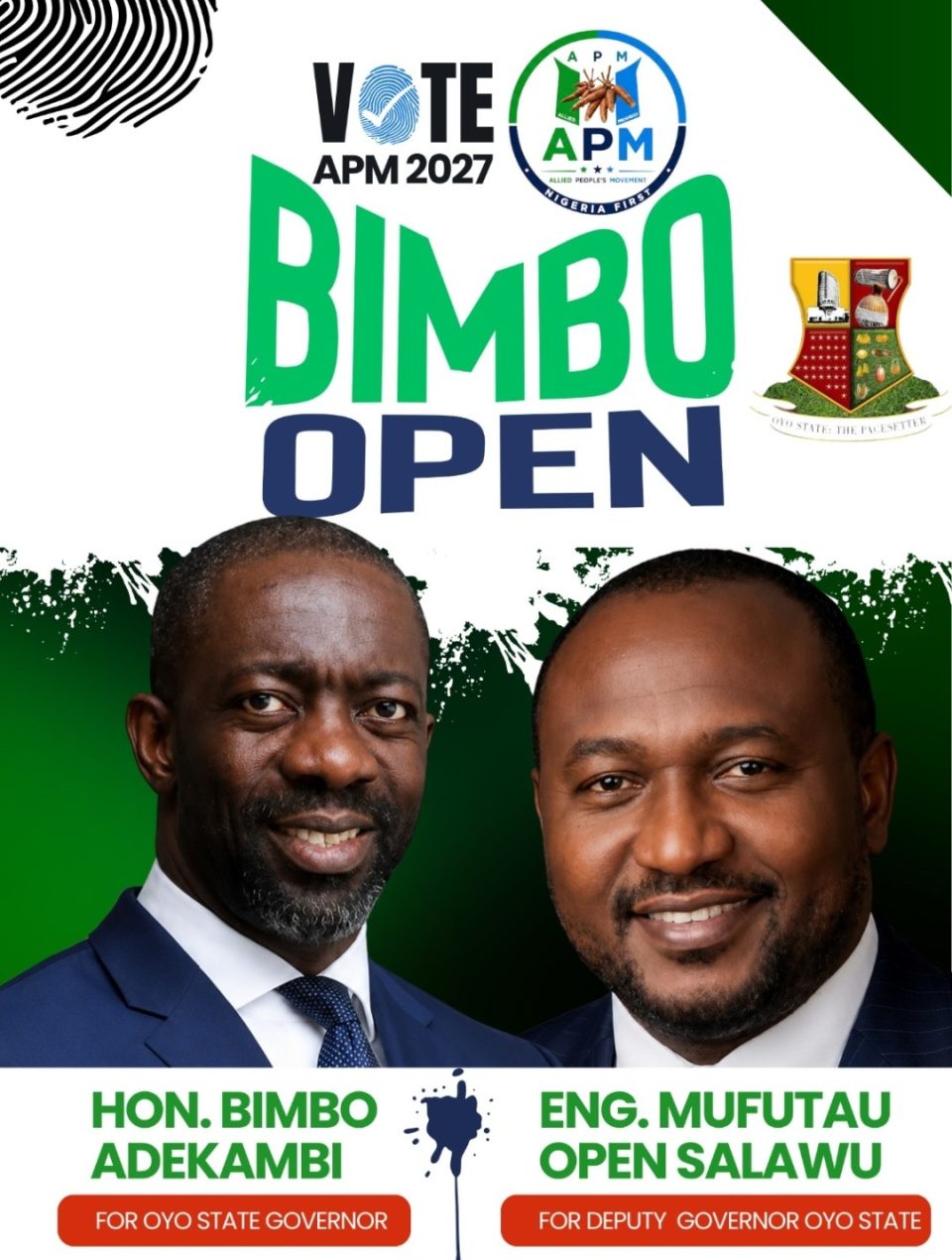
For supporters of the Bimbo Adekanmbi/Open Salawu gubernatorial ticket of the Allied People’s Movement (APM), the answer lies in a leadership proposition built around proven capacity, institutional continuity and sustainable development.
The argument rests on a fundamental principle of governance: progress is not measured by how dramatically an administration changes direction, but by how effectively it builds upon established achievements, corrects shortcomings and creates opportunities for the future. In this context, the Bimbo/Open mandate presents itself as a call for Oyo State to prioritise experience over political experimentation, competence over uncertainty and purposeful continuity over disruption without a clearly defined developmental alternative.
Under Governor Seyi Makinde, Oyo State has pursued a broad development agenda encompassing infrastructure, agribusiness, public-sector reforms, healthcare, education and initiatives aimed at improving the state’s economic competitiveness. These policy directions have shaped an important conversation about the future of governance in Oyo: how can ongoing investments be sustained, public institutions strengthened and the benefits of development extended to a greater proportion of the population?
The question is particularly relevant as the state approaches another electoral cycle. Political transitions are inevitable in a democracy, but the quality of succession often determines whether development gathers momentum or loses direction. A responsible successor must understand that government is not an isolated political project whose achievements begin and end with the tenure of an individual. It is a continuing public institution in which policies, investments and reforms should be evaluated on their merits and sustained where they serve the public interest.
For advocates of the Bimbo/Open mandate, this is the significance of Makinde’s developmental foundation. They argue that the next administration should build on existing progress, complete worthwhile projects, address outstanding challenges and introduce improvements capable of delivering greater value to the people. Such continuity should not be mistaken for an endorsement of every existing policy or an argument against legitimate criticism. Rather, it recognises that development is most sustainable when political succession is guided by institutional memory, sound judgement and measurable public outcomes.
The attraction of Bimbo Adekanmbi to supporters of the APM ticket rests substantially on his administrative experience, financial expertise and perceived capacity to navigate the complexities of government. His previous service as Commissioner for Finance and Deputy Chief of Staff under the late Governor Abiola Ajimobi, alongside his engagement with the Makinde administration, provides relevant exposure to public finance, executive coordination and the demands of government administration.
For a state balancing infrastructure commitments, revenue generation, economic development and social investment, familiarity with the financial and institutional architecture of government can be a considerable advantage. Beyond experience, Adekanmbi’s supporters point to his brilliance, analytical capacity and native intelligence as attributes that could strengthen his approach to leadership. These qualities, when combined with discipline and sound policy judgement, can help a leader assess competing priorities, identify practical solutions and anticipate the implications of government decisions.
In public administration, knowledge establishes a foundation, but judgement determines how effectively that knowledge is applied. The ability to understand complex problems, interpret circumstances and translate ideas into workable policies is central to effective leadership. Adekanmbi’s candidacy therefore offers an argument that extends beyond political allegiance: that Oyo’s next phase of governance requires a leader with sufficient institutional familiarity and intellectual capacity to consolidate existing investments while developing fresh strategies for economic and social advancement.
The ultimate measure, however, must be the translation of these attributes into results—responsible fiscal management, effective project delivery, stronger institutions and tangible improvements in citizens’ welfare.
One of the defining tests of political leadership is the ability to distinguish between what must be preserved and what must be improved. Developmental continuity does not require an incoming government to reproduce the policies of its predecessor without scrutiny. It requires the wisdom to preserve what works, the courage to reform what falls short and the foresight to prepare for challenges that existing policies may not adequately address.
For the proposed Bimbo/Open administration, this would mean sustaining viable infrastructure projects, strengthening public-sector efficiency, expanding economic opportunities, supporting agriculture and small businesses, improving access to quality education and healthcare, and promoting inclusive development across urban and rural communities. It would also require a clear commitment to accountability, transparent public spending and measurable performance indicators by which citizens can assess the administration’s achievements.
The argument for experience is strongest when accompanied by a credible plan for delivery. Previous exposure to government may shorten the learning curve, but it cannot substitute for effective implementation, public consultation and responsible leadership. Consequently, the Bimbo/Open mandate must present continuity not as a political entitlement, but as a responsibility to deliver better outcomes from the foundation already established.
As the Allied People’s Movement advances its political ambitions in Oyo State, the Adekanmbi/Open Salawu ticket offers its supporters a platform to articulate a particular vision of succession: one in which experience, institutional knowledge and developmental consistency take precedence over the attraction of novelty alone. The underlying proposition is that political change should be judged by the quality of the future it promises, not merely by its ability to distinguish itself from the past.
For Oyo, the stakes extend beyond party competition. They concern the completion of public projects, the sustainability of government programmes, the creation of employment opportunities, the effective management of public resources and the capacity of institutions to serve successive generations. Adekanmbi’s administrative background and perceived intellectual strengths provide a basis for making the case for his candidacy, while Open Salawu’s proposed role in the ticket forms part of the leadership partnership that supporters must demonstrate can deliver coordinated, inclusive and effective governance.
Ultimately, their appeal will depend on the clarity of their policy commitments, the credibility of their implementation plans and their readiness to submit their performance to public scrutiny. The history of development is rarely written by those who merely inherit opportunities. It is written by those who understand their value, strengthen their foundations and transform them into lasting public benefits.
For supporters of the Bimbo/Open mandate, Adekanmbi represents a potential bridge between the developmental direction established under Makinde and the next phase of Oyo State’s aspirations. Their argument is that the state should approach succession with strategic clarity, weighing candidates not simply by political popularity or campaign rhetoric, but by their experience, judgement, competence and capacity to deliver sustainable progress.
Nevertheless, democratic succession remains the prerogative of the electorate, and every candidate must be assessed against credible alternatives. No political legacy should be beyond scrutiny, just as no candidate should be beyond accountability. The essential question is whether the next administration can preserve valuable gains, address existing deficiencies and create a more prosperous future for the people of Oyo State.
For the APM and its supporters, the Bimbo/Open ticket is the vehicle through which that ambition is being advanced. Their message is clear: experience over political experiments, continuity with purpose, competence with accountability, and progress that endures beyond personalities and electoral cycles.
As Oyo looks towards 2027, the Bimbo/Open proposition invites voters to consider a fundamental truth: the future is best secured not by abandoning the lessons of yesterday, but by applying them intelligently to the opportunities of tomorrow.
The baton of development must not merely change hands; it must advance the journey.
