
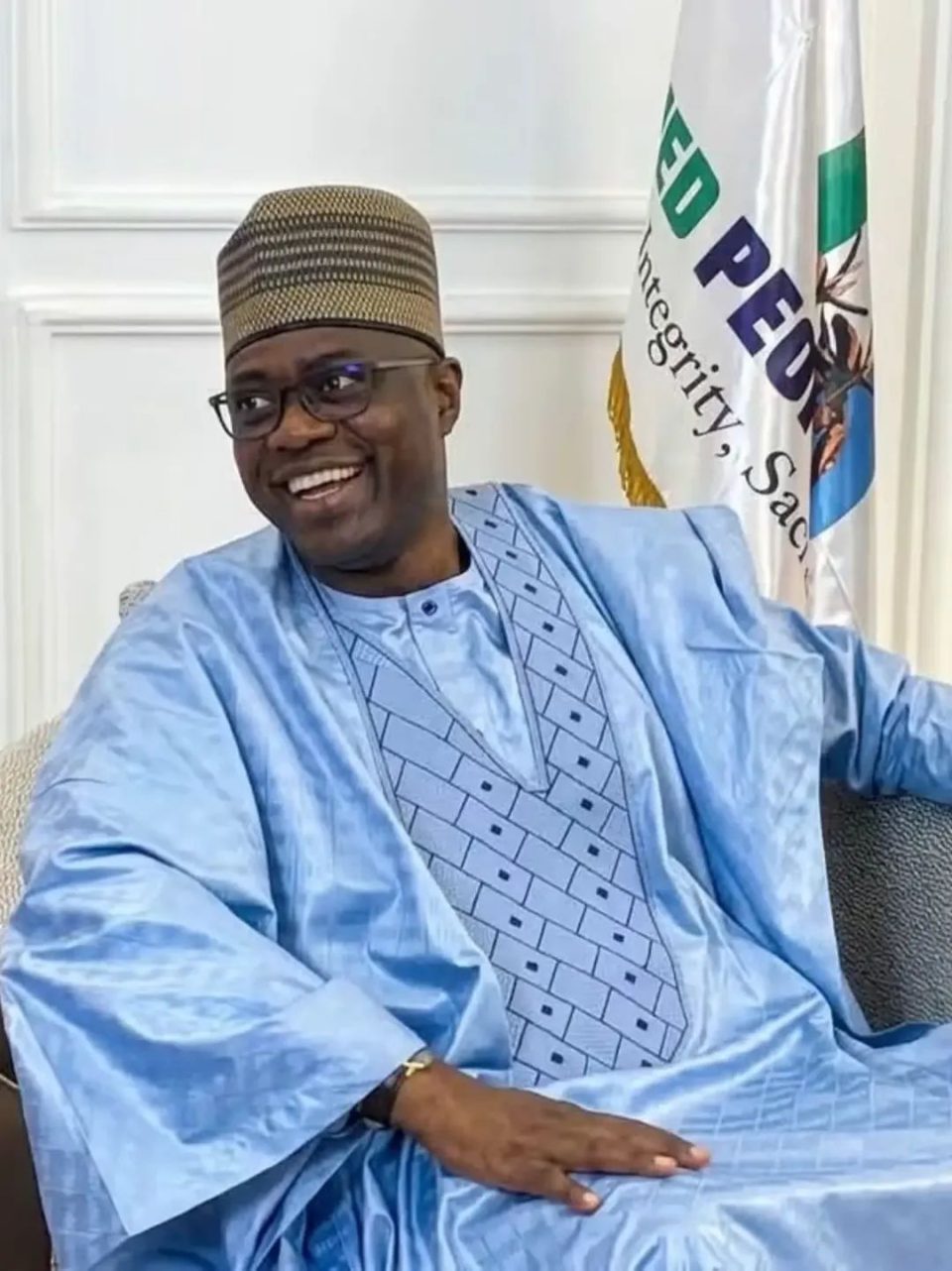
By Ayantoye Christopher | Opinion.
There comes a time in the life of a nation when politics must move beyond the excitement of promises and return to the evidence of performance.
Nigeria is approaching such a moment.
For decades, Nigerians have listened to grand declarations about transforming the economy, fixing education, rebuilding healthcare, securing the nation and restoring dignity to the vulnerable. Yet, too often, the distance between political rhetoric and governance has remained painfully wide.
This is why the story of Seyi Makinde in Oyo State deserves a serious national conversation.
Not because Oyo is Nigeria.
It is not.
But because Oyo offers something every presidential contender should be required to present: a living laboratory of what his leadership philosophy looks like when entrusted with public responsibility.
From Omituntun 1.0 to Omituntun 2.0, Makinde’s administration has built its development strategy around the economy, education, healthcare and security, while extending the programme into infrastructure, transportation, agriculture, energy, youth development and social inclusion.
The real question, therefore, is not whether Oyo’s story is perfect.
No government is.
The question is whether the philosophy behind that story can be enlarged.
Can what has been attempted in Oyo be transformed into a national development project?
That is where the Makinde presidential proposition becomes intriguing.
FROM OMITUNTUN 1.0 TO OMITUNTUN 2.0: A GOVERNANCE PHILOSOPHY, NOT JUST A SLOGAN
Omituntun 1.0 was built around accelerated development.
It was about establishing foundations.
Omituntun 2.0 moved the conversation toward sustainability and consolidation.
That progression matters.
Good governance should not begin afresh every four years. It should build upon what already works, correct what does not and continuously raise the standard.
Makinde’s political narrative has increasingly been constructed around that principle.
The administration’s economic agenda has sought to move Oyo from dependence toward greater productive capacity, with agriculture and agribusiness playing a central role. Government figures have cited more than N27 billion in private agribusiness investment attracted during the first three years of the administration.
The bigger idea is more important than the figure:
Government must create an environment in which wealth can be produced, not merely distributed.
That is precisely the kind of thinking Nigeria needs.
AN ECONOMY THAT MUST PRODUCE BEFORE IT CAN PROSPER
Nigeria’s greatest economic challenge is not a shortage of resources.
It is the failure to consistently convert resources into broad-based prosperity.
A nation blessed with oil, gas, fertile land, human capital, a huge consumer market and an extraordinarily entrepreneurial population should not permanently struggle with unemployment, inflation, insecurity and widespread poverty.
Makinde’s Oyo experiment suggests an alternative approach: strengthen production, encourage investment, improve infrastructure and make government increasingly capable of funding development from a stronger economic base.
Oyo’s reported rise in internally generated revenue is part of that broader story.
But the national lesson is even bigger.
Nigeria must graduate from an allocation mentality to a production mentality.
That means agriculture that feeds industries.
Industries that create jobs.
Infrastructure that lowers the cost of doing business.
Energy that powers production.
Education that produces employable citizens.
And government that understands that the private sector is not its enemy but an essential partner in development.
EDUCATION: BUILDING THE NATION BEFORE BUILDING THE FUTURE
A nation cannot build a better future with an education system trapped in the past.
Under Makinde, education has remained one of the four central pillars of governance. The administration has reported hundreds of education projects involving model schools, classrooms, renovations, boreholes and other facilities.
But the deeper significance lies in the philosophy.
Education must be treated as national infrastructure.
Not an afterthought.
Not merely another ministry.
Not simply examination preparation.
Nigeria requires an education revolution that connects primary and secondary education with technical skills, entrepreneurship, digital competence, science, engineering, vocational training and the demands of a modern economy.
If Makinde’s governance philosophy can be successfully translated from a state education agenda into a federal human-capital strategy, the potential impact would be enormous.
HEALTHCARE THAT REMEMBERS THE ORDINARY CITIZEN
One of the strongest tests of government is what happens to the citizen who does not have money to travel abroad for treatment.
Makinde’s administration has invested heavily in primary and secondary healthcare infrastructure. At one stage, the government reported the completion of 206 of 299 awarded primary healthcare-centre projects, alongside upgrades to secondary facilities including Ring Road State Hospital, Adeoyo and other hospitals.
The lesson is simple:
Healthcare must begin where the people are.
Nigeria needs a system in which primary healthcare is functional, hospitals are properly equipped, health workers are supported and citizens are not forced into catastrophic expenditure merely because they became ill.
A national version of that philosophy would mean moving healthcare from emergency response to preventive and accessible care.
INFRASTRUCTURE THAT CONNECTS PEOPLE TO OPPORTUNITY
Roads are not merely roads.
They are economic arteries.
A good road connects farmers to markets, workers to jobs, businesses to customers and communities to government.
Makinde’s infrastructure programme has consequently extended beyond conventional road construction into transportation and other public infrastructure.
This is the kind of thinking Nigeria requires at scale.
The Lagos-Ibadan corridor should not merely be a transport route.
Ports should connect efficiently to industries.
Rail should connect production centres to markets.
Airports should support commerce and tourism.
Rural roads should connect farmers to aggregation and processing centres.
Infrastructure should ultimately be judged by one question:
How much economic activity does it unlock?
SECURITY: GOVERNMENT MUST PROTECT THE POSSIBILITY OF PROSPERITY
There can be no meaningful investment without security.
No functioning school without security.
No thriving agriculture without security.
No tourism without security.
No stable society without security.
The Makinde administration has supported security agencies with operational vehicles, communication equipment, protective gear and other logistics.
But Nigeria needs to go further.
A national security strategy must combine intelligence, technology, border management, community participation, modern policing, economic opportunity and decisive action against violent criminal networks.
Security must not merely protect government.
It must protect the citizen’s ability to live, work, invest and dream.
BUT PERHAPS THE MOST IMPORTANT STORY IS THE PEOPLE NOBODY USED TO SEE
There is another dimension of Makinde’s Oyo story that deserves far more national attention.
Persons with disabilities.
For too long, disability communities in Nigeria have been treated as objects of charity rather than citizens of equal dignity.
Their struggles have often been reduced to wheelchairs, alms and occasional political gestures.
That narrative deserves to die.
Under Makinde, Oyo has increasingly moved disability governance toward representation, inclusion, employment, accessibility and dignity.
The state disability agency has become a more visible instrument of public policy, while the administration has recorded measures including the appointment of a person with disability as an Executive Assistant and increased governmental attention to disability inclusion.
In 2025, the state also increased its capital budgetary allocation for persons with disabilities by more than 70 per cent.
These things matter.
Because inclusion is not simply about giving someone a wheelchair.
It is about giving someone a place.
A voice.
An opportunity.
A livelihood.
A political identity.
A sense that government sees them not as burdens but as citizens.
That is the real transition: from rejection to recognition; from pity to dignity; from the margins to the mainstream.
And if there is one lesson Nigeria could learn from that transformation, it is this:
A government should be measured by how much dignity it creates, not merely by how much concrete it pours.
FROM THE PERSONS WITH DISABILITIES TO EVERY NIGERIAN
The same principle should define national governance.
The poor should not be invisible.
The unemployed graduate should not be invisible.
The farmer should not be invisible.
The market woman should not be invisible.
The artisan should not be invisible.
The young entrepreneur should not be invisible.
The elderly should not be invisible.
The person living with disability should not be invisible.
The ordinary Nigerian should never have to become politically powerful before government remembers that he exists.
That is where the Makinde proposition becomes larger than Oyo politics.
WHAT IF OMITUNTUN BECOMES A NATIONAL PHILOSOPHY?
Imagine an Omituntun philosophy applied nationally.
An economy driven by production.
An education system designed for the jobs of tomorrow.
A healthcare system that works from the primary-care level upward.
Infrastructure designed around economic productivity.
Agriculture connected to processing and export.
Energy treated as the foundation of industrialisation.
Technology used to make government more transparent and efficient.
Young Nigerians empowered to become producers, innovators and employers.
Persons with disabilities integrated into the economic and political mainstream.
States encouraged to become productive rather than permanently dependent.
And a federal government that sees its role not merely as sharing national wealth, but as creating the conditions under which Nigerians can create wealth themselves.
That is the larger possibility.
MAKINDE’S BIGGEST TEST WOULD BEGIN IN ABUJA
Yet there is a necessary caution.
Nigeria is vastly more complicated than Oyo State.
The presidency carries responsibilities that no state governor encounters at the same scale: monetary and fiscal coordination, national security, foreign affairs, defence, borders, federal institutions, energy policy, national infrastructure and a massive bureaucracy.
Therefore, nobody should pretend that a successful governorship automatically guarantees a successful presidency.
But it does provide something valuable:
evidence.
Evidence of how a leader thinks.
Evidence of how he manages resources.
Evidence of what he prioritises.
Evidence of how he treats vulnerable citizens.
Evidence of whether his promises can translate into programmes.
And evidence of whether he can sustain a policy direction beyond campaign season.
That evidence is what Nigerians should interrogate.
THE REAL QUESTION FOR 2027
Nigeria does not need another election determined entirely by emotion.
It needs a conversation about competence.
It needs a conversation about economic productivity.
It needs a conversation about institutions.
It needs a conversation about human dignity.
It needs a conversation about how to turn Nigeria’s enormous potential into measurable prosperity.
And above all, Nigerians deserve the opportunity to ask every presidential candidate:
“Show us what you have done.”
For Makinde, Oyo provides the answer.
From Omituntun 1.0 to Omituntun 2.0, the administration has presented a model built around economic expansion, education, healthcare, security, infrastructure and inclusion. The federal government itself has described the administration’s current direction in terms of inclusive growth, stronger institutions, youth empowerment and sustainable development.
The next question is whether those ideas can survive the transition from Ibadan to Abuja.
Whether they can be expanded.
Whether they can be improved.
Whether they can become national policy.
And whether Nigeria is finally ready for a leadership conversation that moves from “who can promise the most?” to “who has demonstrated the capacity to deliver?”
Nigeria does not need another political mirage.
It needs a mirror.
And perhaps that mirror is already visible in Oyo.
Omituntun began as a roadmap for Oyo.
The bigger question now is whether it can become a roadmap for Nigeria.
Because if Oyo was the laboratory, Nigeria is the canvas.
And if the objective is truly to Reset Nigeria, then the country deserves to ask whether the man who has spent years building a development model in Oyo is ready to attempt the harder task of building it at the centre.
Nigeria with Seyi Makinde may ultimately be less about one man’s ambition and more about one country’s willingness to believe that governance can once again be measured by results, inclusion and the dignity it restores to its people.
